

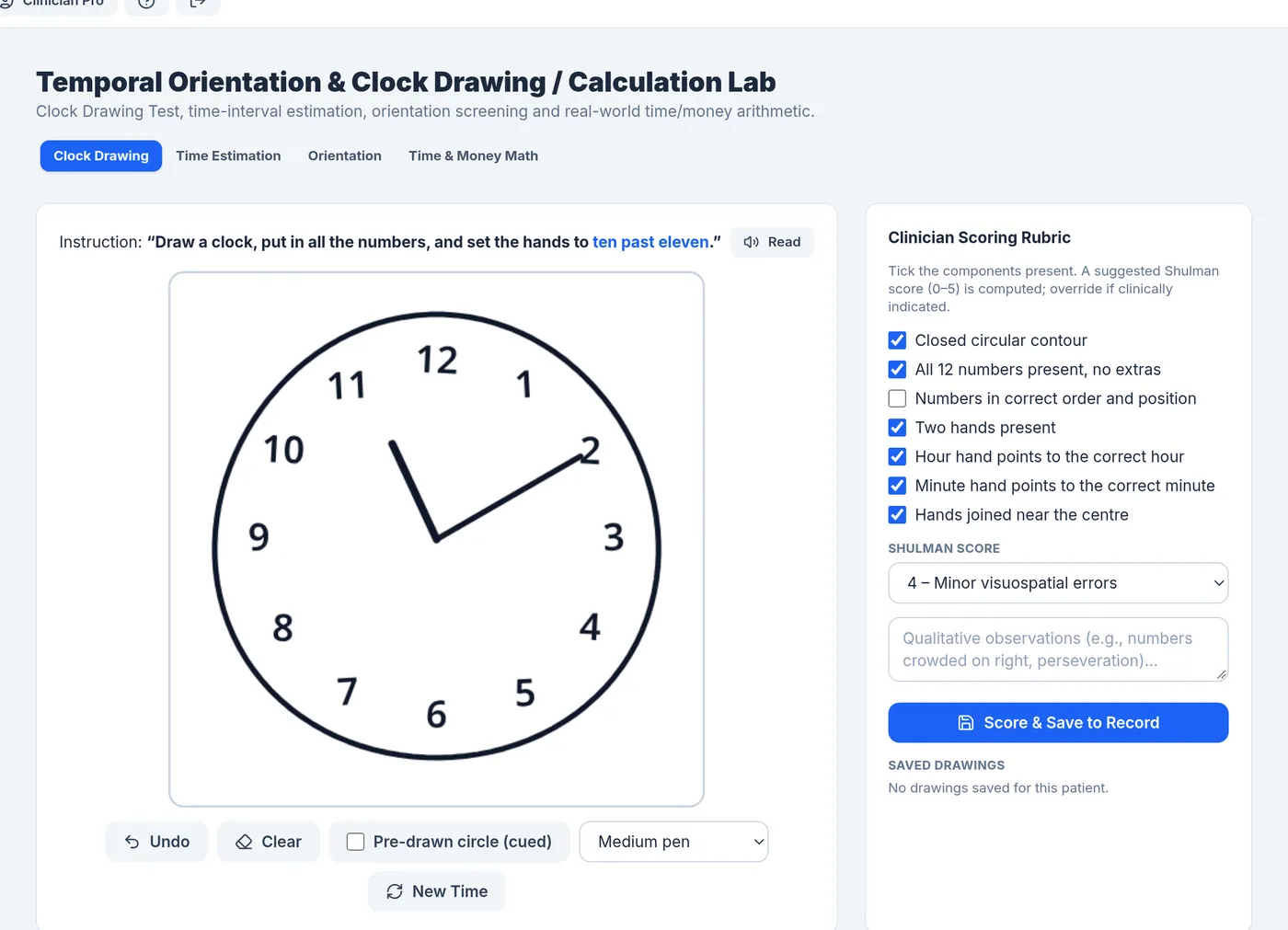
Clock drawing
The patient is asked to “draw a clock, put in all the numbers, and set the hands to” a stated time, such as ten past eleven or quarter to three. The instruction can be read aloud. Drawing works with a mouse, a finger on a touchscreen or a stylus. There are three pen widths (including a thick pen for tremor), undo and clear, and an optional pre-drawn circle when a cued version is appropriate.
The clinician scores the drawing with a checklist:
- Closed circular contour
- All 12 numbers present, no extras
- Numbers in the correct order and position
- Two hands present
- Hour hand pointing to the correct hour
- Minute hand pointing to the correct minute
- Hands joined near the centre
From the ticked items CogniStride suggests a score on a 0–5 scale modelled on the Shulman clock-drawing levels, from 5 (perfect clock) to 0 (no reasonable representation of a clock). The clinician can override it and add notes. A thumbnail of the drawing is saved with the result, so drawings can be compared over time.
Time-interval production
The patient presses Start, then Stop when they think 10, 30 or 60 seconds have passed, without a clock. After three trials CogniStride records the mean absolute error and whether the patient tends to stop early or late.
Temporal orientation
Five questions: the year, month, date, day of the week and season. Answers are checked against the device clock. The season accounts for the hemisphere, and either season is accepted in transition months (March, June, September and December). The result is a score out of five, with the errors listed.
Time and money calculation
A block of six randomly generated everyday problems: arrival time after a journey, change from $20, counting coins, the next medication dose, the length of a TV programme, and comparing unit prices. Each problem is scored on the first answer.
Limits
The clock score is a structured clinical judgement aid, not an automated or validated scoring algorithm. See Clock drawing: administration & 0–5 scoring for how the levels are usually described.