

Two tasks, one measure of conflict
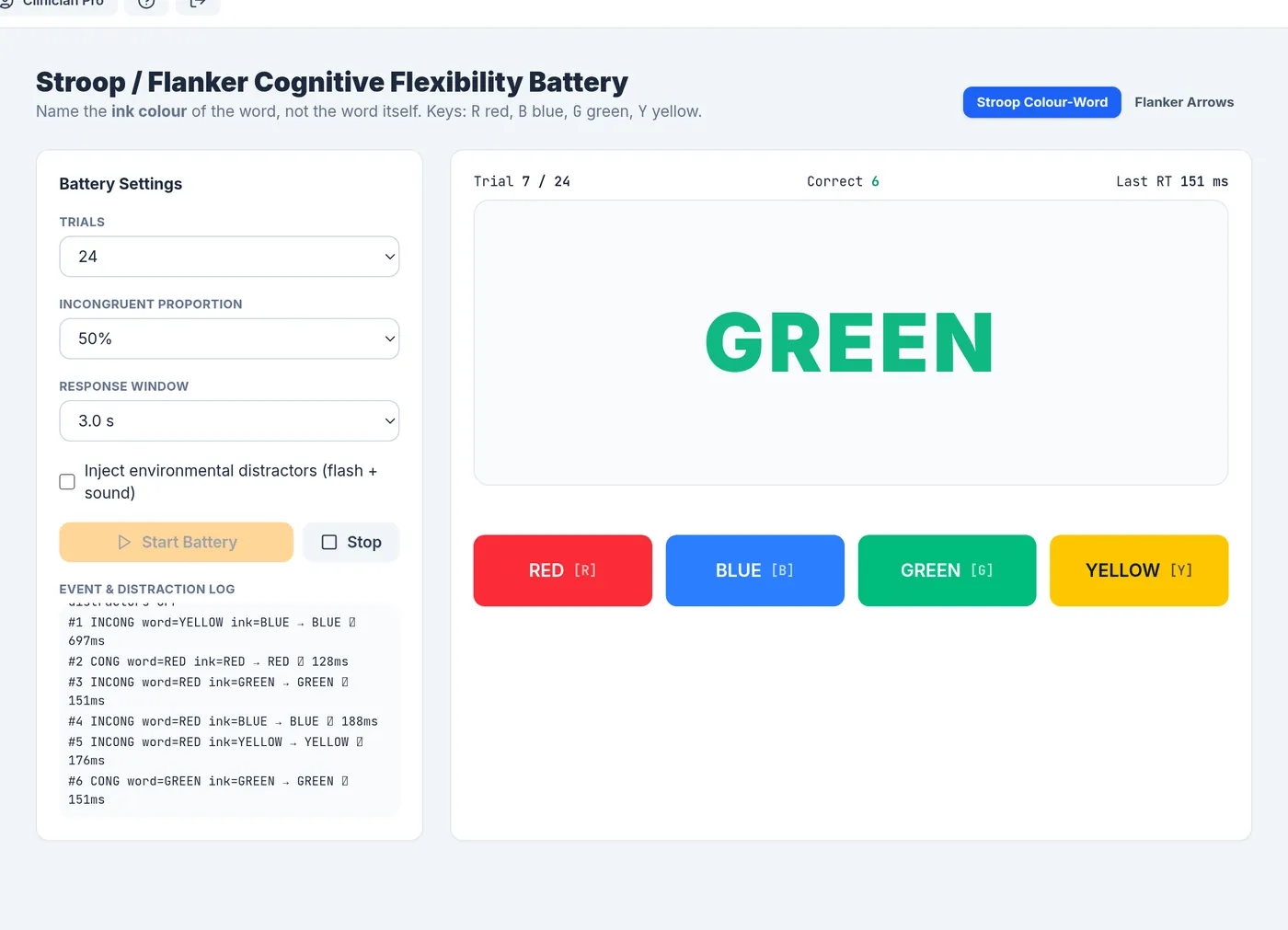
In the Stroop task the word RED might be printed in blue ink; the patient answers with the ink colour, not the word. In the Flanker task the patient answers with the direction of the centre arrow while the arrows around it point the same way (congruent) or the opposite way (incongruent).
Both tasks compare congruent and incongruent trials. Responding to incongruent trials is usually slower, and the difference, the interference cost, reflects how much the conflicting information gets in the way.
How a block runs
- Choose the task, the number of trials, the share of incongruent trials (30%, 50% or 70%) and the response window.
- Each trial starts with a fixation cross, then the stimulus appears. Answer with the large on-screen buttons or the keyboard: R B G Y for colours, ← → for arrows.
- No answer within the response window counts as an omission.
- Every trial is written to an on-screen event log as it happens: condition, stimulus, response, correctness and reaction time.
Environmental distractors
An optional distractor mode flashes a bell icon and plays a short beep at a random moment during about 30% of trials. The log marks those trials, and the results show how many errors happened on distracted trials, which is useful for patients returning to busy workplaces or classrooms.
What is recorded
| Measure | What it means |
|---|---|
| Accuracy | Correct responses across all trials, and separately for congruent and incongruent trials |
| Congruent / incongruent RT | Mean reaction time on correct trials of each type |
| Interference cost | Incongruent minus congruent reaction time, in milliseconds |
| Omissions | Trials with no response inside the window |
| Distractor errors | Errors on trials where a distractor appeared |
Limits
Reaction times depend on the device, input method and the patient’s motor speed, so compare a patient with their own earlier sessions on the same setup rather than with other people. The task origins are listed on Methods & references.