

What the exercise is
The n-back is a widely used working-memory task: each stimulus has to be compared with the one shown N steps earlier, so the patient must hold and continually update a short sequence in mind. The dual version presents a position and a sound at the same time, and each is judged separately.
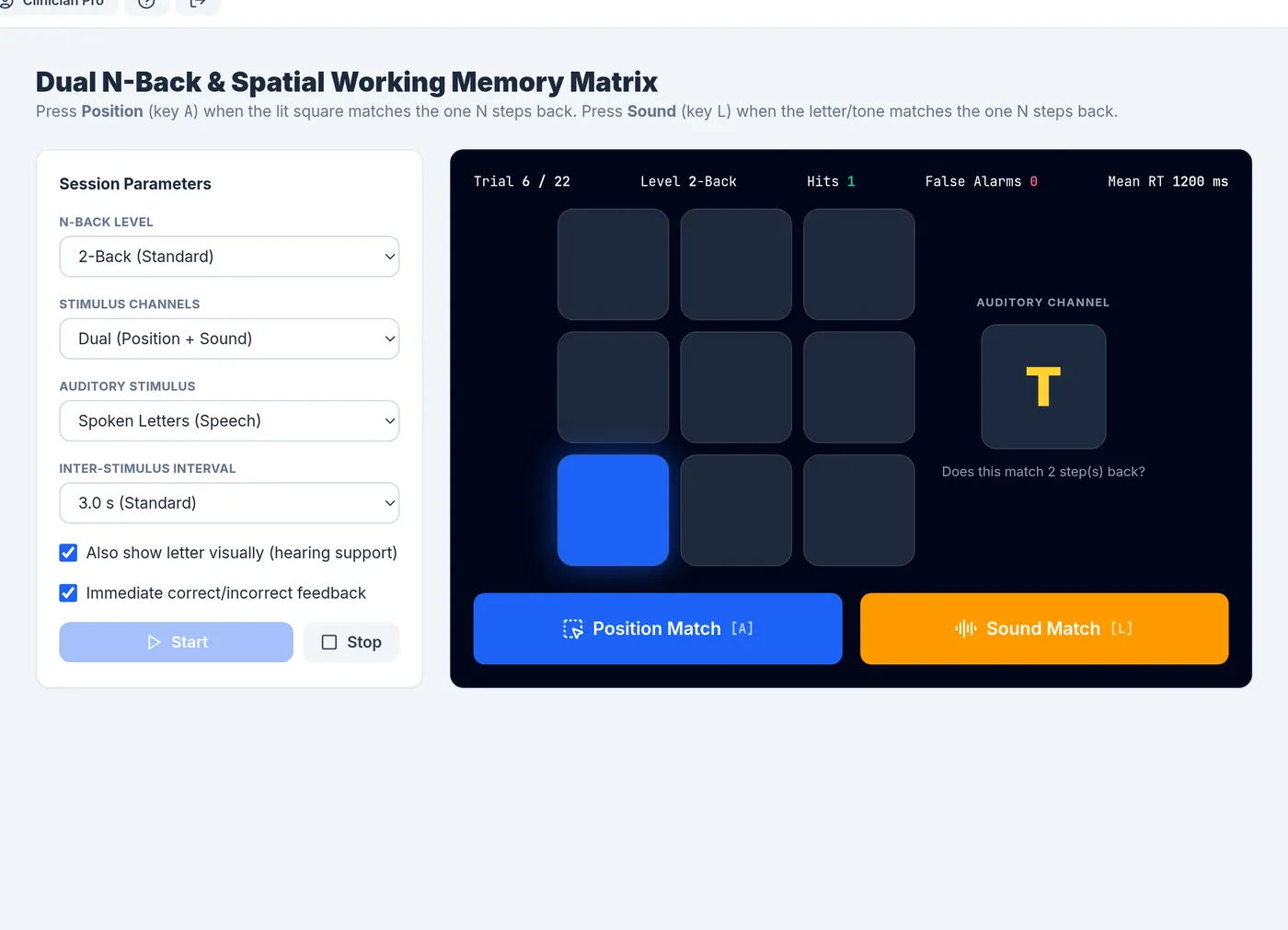
In CogniStride a square lights up in a 3×3 grid while a letter is spoken (or a tone is played). The patient presses Position Match (key A) when the square is in the same place as N steps back, and Sound Match (key L) when the letter is the same. Spatial-only and auditory-only modes are available when one channel is enough.
How a block runs
- Choose the level (1–4), the channels, the auditory stimulus (spoken letters or pure tones) and the pace (2.0–3.5 seconds between stimuli).
- The first N stimuli are for memorising only; the on-screen prompt says how many remain before matching starts.
- About 30% of the remaining trials on each channel are generated as matches, so there are always targets to find and non-targets to ignore.
- After 20 + N trials the block ends and the results are logged to the patient’s record.
What is recorded
| Measure | What it means |
|---|---|
| Hits / misses | Matches that were and weren’t responded to |
| False alarms | Responses when there was no match |
| Balanced accuracy | Average of the hit rate and the correct-rejection rate, so pressing on every trial does not score well |
| d′ (sensitivity) | A signal-detection measure separating real discrimination from response bias |
| Mean hit reaction time | Milliseconds from stimulus to a correct response |
At the end of each block CogniStride suggests a level for next time: move up after 85% or more, step down at 50% or less, otherwise stay. The suggestion is a rule of thumb, not a clinical recommendation.
Accessibility options
- Show the letter on screen as well as speaking it, for patients with hearing loss.
- Slower pacing (3.5 seconds) for patients with aphasia or slower processing.
- Large response buttons, keyboard shortcuts and switch-control support for limited hand movement.
- Immediate feedback (a green or red ring on the button) can be turned off for a less pressured block.
Limits
Practice on n-back tasks reliably improves performance on n-back tasks; whether it transfers to everyday memory is debated in the research literature. CogniStride records performance on this task and does not claim broader effects. See Methods & references for the task’s origins.